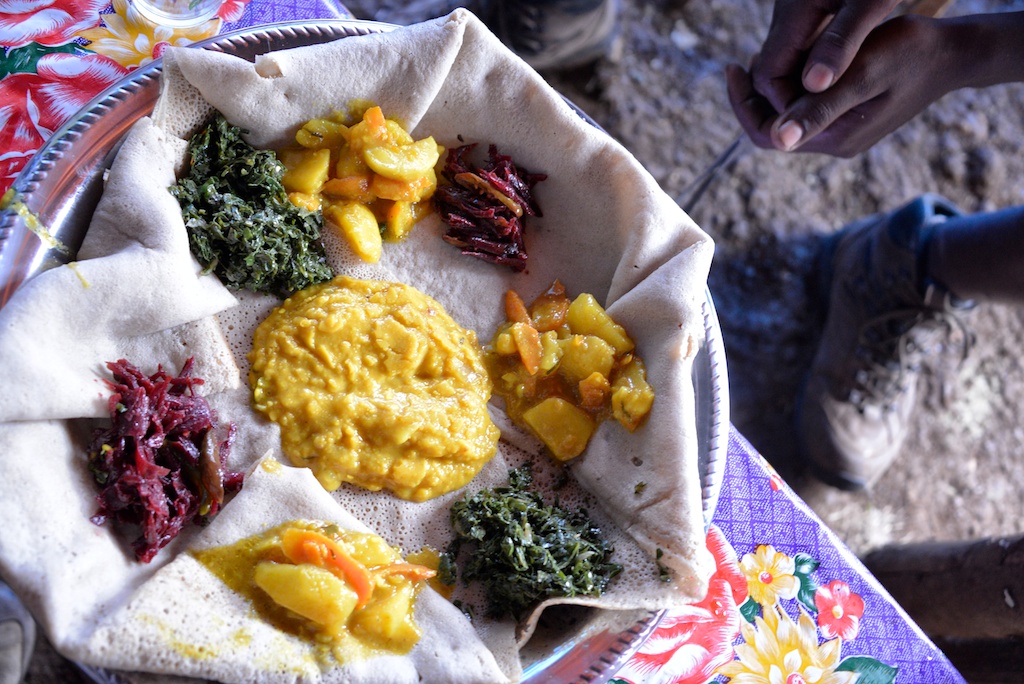
The first time one of us ordered a "veggie combo" at an Ethiopian place in Harlem, we expected a polite side dish. What came was a tray the size of a car tyre: a grey, spongy pancake laid flat, with seven or eight little mounds of colour spooned around it. Red lentils, glowing turmeric peas, collard greens, a pale orange stew that tasted of garlic and toasted chickpeas, a tumble of cabbage and carrot. Extra rolls of bread came folded on the side like napkins. Nobody at the table missed the meat. Nobody even mentioned it.
That tray has a name, yetsom beyaynetu, roughly "a bit of every kind of fasting food." And the reason it exists is one of the best stories in plant-based cooking.
A calendar full of fasting days
The Ethiopian Orthodox Tewahedo Church keeps one of the most demanding fasting calendars in the Christian world. Most Wednesdays and Fridays are fast days. On top of those sit the long seasons: the great fast before Easter (more than fifty days), the fast before Christmas, a fortnight in August before the feast of the Virgin Mary, and several shorter ones. Add it up and devout lay people fast for something like 180 days a year. Priests and monks go further.
On a fasting day the rule is simple: no meat, no milk, no butter, no eggs. Many people also go without food until the afternoon. That leaves a huge share of the year when a large part of the country eats, by modern definitions, vegan.
Ethiopian cooks did not respond by eating plain boiled vegetables for half the year. They built an entire parallel cuisine, ye-tsom migib (fasting food), with the same depth and heat as the meat dishes. The trick was mostly in what replaced the butter.
In much of the world, vegan food is a modern invention. In Ethiopia it is roughly as old as the church itself.
Injera: the plate you eat
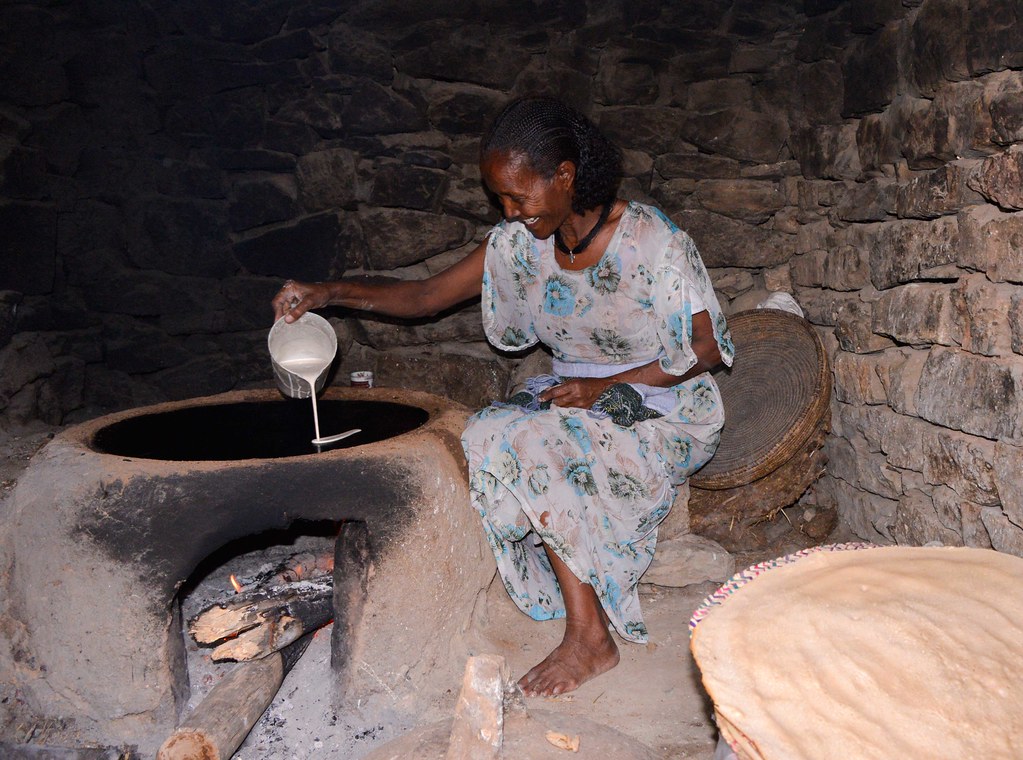
Everything sits on injera, the sour, bubbly flatbread made from teff. Teff is a tiny grain native to the Ethiopian highlands, with seeds so small that a handful can sow a field. The flour is mixed with water and a splash of liquid saved from the last batch, then left to ferment for a few days until it smells pleasantly sour.
The batter is poured in a spiral onto a wide clay griddle called a mitad and covered at once, so it half bakes and half steams. It is never flipped. As it cooks, the surface fills with tiny holes, which Ethiopians call "eyes." Those eyes are the point: they soak up the sauces.
One honest note for New Yorkers: teff is expensive, and many restaurants in the US mix it with wheat or barley flour. If you avoid gluten, ask whether the injera is 100% teff.
What is on the tray
Every kitchen fills its beyaynetu a little differently, but you will usually find most of these:
- Misir wot: red lentils cooked down with berbere, the brick-red chilli blend. Usually the spiciest thing on the plate.
- Kik alicha: yellow split peas with turmeric, ginger and garlic. "Alicha" means mild, and it is the cooling counterweight to the misir.
- Shiro: a smooth stew made from roasted, ground chickpeas or broad beans. Comfort food. Many Ethiopians would choose it over everything else.
- Gomen: collard greens with garlic and green chilli.
- Atakilt wat: cabbage, carrot and potato, soft and gently spiced.
- Azifa: a cold green-lentil salad sharpened with mustard and lime, served on some days.
- Timatim: tomato and onion salad with green chilli, sometimes tossed with torn injera.
The butter question
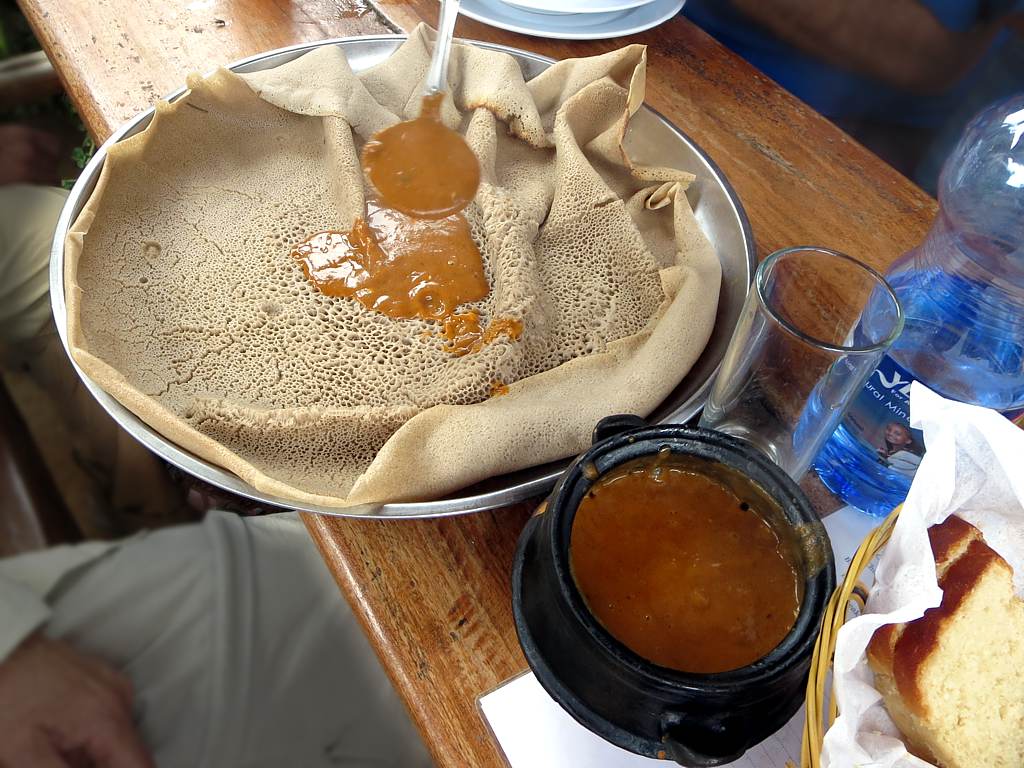
On non-fasting days, many Ethiopian stews are finished with niter kibbeh, butter that has been clarified and steeped with spices like fenugreek, cardamom and a herb called koseret. On fasting days it is simply replaced with oil. That swap is the whole reason the platter is vegan, and it is also why you should ask your waiter one question: "Is this ye-tsom?" If the answer is yes, there is no butter in it.
The other technique worth knowing is how onions are cooked. Ethiopian cooks often start a wot by stirring chopped onions in a dry pot, with no fat at all, until they soften and give up their water. Only then does the oil go in. It produces a deep, sweet base that tastes as if it had been simmering all afternoon.
How to eat it (and not embarrass yourself)
Use your right hand. Tear a piece of injera from the extra rolls, pinch up some stew with it, and eat bread and food together. Start from the edge of the tray nearest you. Do not worry about neatness; a good beyaynetu is supposed to get messy. When the stews are gone, the injera underneath, soaked with all of them, is often the best bite of the meal.
If someone at the table offers you a gursha, a bite placed straight into your mouth, it is a gesture of friendship. Saying no is a little like refusing a toast.
Cook it: misir wot (spicy red lentils)
You need
- 2 red onions, very finely chopped
- ¼ cup neutral oil
- 2–3 tbsp berbere (start low)
- 4 garlic cloves, grated
- 1 tbsp grated ginger
- 2 tbsp tomato paste
- 1½ cups red lentils, rinsed
- 4 cups water or vegetable stock
- Salt to taste
Method
- Put the onions in a dry heavy pot over medium-low heat. Stir often for 10 minutes until they soften and look almost jammy. Splash in a spoon of water if they catch.
- Add the oil and cook 5 minutes more. Stir in the berbere, garlic and ginger and fry for 2 minutes, until fragrant.
- Add the tomato paste, then the lentils and 3 cups of the water. Bring to a simmer.
- Cook 25–30 minutes, stirring and adding water as needed, until the lentils collapse into a thick stew.
- Season with salt. It should be loose enough to spoon, thick enough to sit on injera without running.
Find it in New York
Harlem has the city's best-known cluster of Ethiopian restaurants, and there are more in Brooklyn and Queens. Wednesdays and Fridays are good days to go: some kitchens make extra fasting dishes. Ask for the vegetarian or fasting combination and confirm it is ye-tsom. For teff flour and berbere to cook at home, look in Ethiopian and African grocery stores, or in the international aisle of larger health-food shops.
A note on respect
For many Ethiopians, fasting is a religious practice first and a diet second. We write about the food because it is wonderful, not to turn a faith tradition into a trend.
Further reading: Ethiopian cuisine · Injera · Ethiopian Orthodox Tewahedo Church (Wikipedia overviews with their own citations).